5 Signs Your Concrete Driveway Needs Resurfacing (Not Replacing)
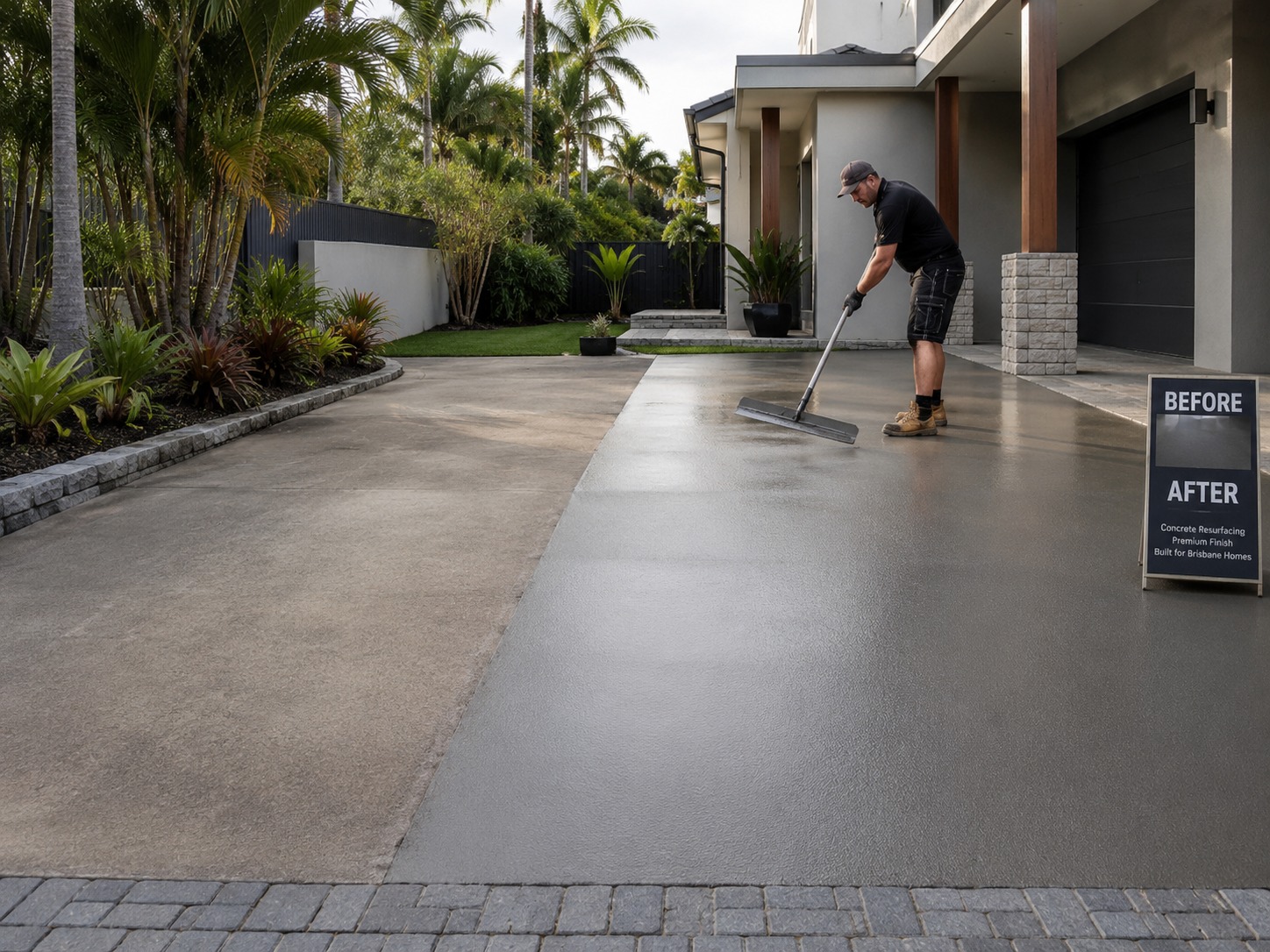
Key Takeaways
- Resurfacing costs $3,000–$6,000 vs $8,000–$12,000 for full replacement — a saving of 40–60% for the same end result.
- Resurfacing only works when the underlying slab is structurally sound — an on-site assessment tells you which applies.
- Stains, scaling, hairline cracks, and faded finishes are cosmetic — all resurfaceable without breaking out a single slab.
In This Article
There's a common assumption among Brisbane homeowners that a tired-looking concrete driveway means a full replacement. Stained, cracked, faded, uneven — most people see those issues and immediately start budgeting for a complete rip-out and re-pour. But here's the truth most Brisbane concrete contractors won't volunteer up front: in many cases, your driveway doesn't need replacing at all. It needs resurfacing.
The catch? Resurfacing only works if the underlying slab is structurally sound. Pour a decorative overlay over a driveway with deep foundational problems and you're throwing money away. Knowing the difference between cosmetic damage and structural failure is the whole game.
Resurfacing vs Full Replacement — Brisbane Cost Comparison
Full Replacement
$8,000–$12,000
Average 60m² Brisbane driveway
- Demolition & removal
- Excavation & sub-base prep
- Formwork & reinforcement
- New concrete pour & finish
Resurfacing
$3,000–$6,000
Same driveway, same result
- Surface prep & crack filling
- Decorative overlay application
- Choice of finish & colour
- Sealing for durability
Save 40–60% with resurfacing
Here are five clear signs your concrete driveway is a strong candidate for resurfacing rather than replacement — and one big warning sign that means you actually do need to start over.
The Damage Is Cosmetic, Not Structural
The single most important question to ask about your driveway is: is the slab itself still doing its job?
A concrete slab's job is to bear weight, distribute load evenly across the ground beneath it, and resist movement from Brisbane's expansive clay soils. If the slab is still doing those three things, almost everything else can be fixed on the surface.
Cosmetic damage that resurfacing handles well includes:
- Surface stains — from oil, rust, fertiliser, or organic matter
- Surface scaling and flaking — where the top few millimetres have worn away
- Faded or discoloured concrete — that's lost its original tone
- Minor pitting and surface texture loss — from years of UV exposure
- Worn-out broom or salt finishes — that have smoothed over with time
- Tyre marks and scuff lines — that won't come out with pressure washing
If your driveway looks bad but still feels solid underfoot — no rocking, no obvious sinking, no large structural cracks — you're almost certainly looking at a resurfacing job, not a replacement. A quality resurfacing system bonds a 6–12mm decorative layer directly to your existing slab and can transform a 20-year-old driveway into something that looks brand new.
Cracks Are Hairline or Surface-Level Only
Cracks scare homeowners more than they should. Not all cracks mean structural failure — in fact, most cracks in residential concrete driveways across Brisbane are completely normal and entirely fixable. The question isn't whether your driveway has cracks. The question is what kind of cracks they are.
Resurfacing Can Fix These
- Hairline cracks under 1mm wide
- Surface cracks (not through the slab)
- Shrinkage cracks from early curing
- Spider-web or map cracking
- Static cracks that aren't growing
Structural — Needs Assessment
- Cracks wider than 5mm
- Cracks running through the full slab
- Active cracks that are still growing
- Cracks with vertical displacement
- Multiple parallel deep cracks
Cosmetic cracks can be cleaned out, filled with flexible crack repair compound, and covered entirely by a resurfacing overlay. A good Brisbane concrete contractor will tap-test the slab, mark each crack, measure its width, and check whether it's active or dormant before recommending anything.
The Driveway Is Level and Stable
Resurfacing is a top-up, not a foundation. It can fix what you see, but it can't fix what's happening underneath. Walk the length of your driveway slowly and pay attention to a few things:
- Does it feel level underfoot? Minor slopes for drainage are normal; sudden dips, raised edges, or noticeable tilts aren't.
- Do the slab joints line up? If one section sits noticeably higher or lower than the next, the ground beneath has moved.
- Does it bounce or rock? A solid slab feels like solid ground. If you can feel any flex, movement, or hollow response, that section has lost contact with the substrate.
- Are there gaps under the edges? Soil washout or erosion under the edges is a warning sign.
Brisbane soils note: Reactive clay soils are notorious for seasonal movement in suburbs like Carindale, Wishart, and parts of the western corridor. A stable driveway in these areas means your original contractor prepared the ground properly. If that's the case, your slab is worth saving — resurfacing can even level out minor lippage of 5mm or less as part of the overlay process.
The Driveway Is Less Than 25–30 Years Old
Concrete is a long-lived material. A properly built Brisbane concrete driveway should last 30 to 50 years before structural replacement is genuinely necessary. If your driveway is somewhere in the first two-thirds of that lifespan, resurfacing is almost always the right call.
First 5–10 years
The honeymoon period. Surface damage during this window is almost never structural. Cosmetic resurfacing brings a young driveway back to brand-new condition for a fraction of the replacement cost.
Years 10–20
Most driveways start showing their age. Sealers have worn off, the surface has scaled, colour has faded, and minor cracks have appeared. This is the resurfacing sweet spot.
Years 20–30
Requires a more careful assessment. The slab might still be perfectly sound, but the chances of underlying issues increase. A reputable contractor should still default to resurfacing if the slab passes a structural check.
Beyond 30 years
The question changes. Older driveways may not have adequate reinforcement or properly compacted sub-bases. Replacement starts becoming more economically rational — but get an assessment first.
If you bought a Brisbane home in the last few years and inherited a tired-looking but solid driveway, age is on your side. Even a driveway poured in 1995 has plenty of structural life left in it if it's been reasonably cared for.
Drainage Still Works Correctly
A driveway's job isn't just to support vehicles. It also has to move water away from your home, your garage, and your foundations. In Brisbane, where summer storms can dump 50mm of rain in an hour, drainage performance matters more than people realise.
Test your driveway's drainage during or right after a heavy rain:
- Does water flow off the surface? It should run consistently toward the street, a stormwater grate, or a designated drainage point.
- Are there pooling areas? Small puddles that dry within an hour or two are fine. Standing water that lingers for half a day or longer indicates a low spot.
- Does water flow toward your home? A driveway that channels water back toward your garage, slab, or foundations is creating a slow-motion structural problem.
- Is there backflow at expansion joints? Water shouldn't sit in joints or seep underneath the slab.
Good drainage = strong resurfacing candidate. Resurfacing maintains the existing slope and drainage pattern while refreshing the surface, so a driveway that drains well now will keep draining well after resurfacing. If drainage is failing, that needs to be addressed first — sometimes fixable within the resurfacing process, sometimes requiring targeted slab or drainage work.
The One Sign That Means You Actually Need Replacement
Resurfacing is the right answer most of the time, but not always. Here's the deal-breaker:
Replacement Needed
Deep structural cracks, slab heaving, or significant sinking that indicates ground failure underneath the driveway.
- Cracks wider than 5mm that run all the way through the slab
- One side of the slab visibly higher than the other (more than 10–15mm lippage)
- Sections that have sunk or tilted significantly
- Visible erosion or voids under the slab edges
- A driveway that flexes or rocks underfoot
In these cases, the slab itself has failed or the ground beneath it has shifted dramatically. No surface overlay will fix that — you'd just be hiding the problem until it telegraphs back through the new finish, usually within a year or two. Honest Brisbane concrete contractors will tell you when they see this and recommend replacement.
The Bottom Line
If your driveway ticks most of those five boxes — cosmetic damage, hairline cracks, solid and level slab, under 25–30 years old, and drainage still working — you almost certainly don't need to spend $8,000–$12,000 replacing it. A proper resurfacing job will give you the same fresh look at less than half the price. The only way to know for certain is a thorough on-site assessment from an experienced concreter who'll tap-test the slab, check the sub-base, and give you an honest answer.
Not Sure If You Need Resurfacing or Replacement?
The only way to know for certain is a proper on-site assessment from an experienced concreter. A thorough inspection takes 30–45 minutes and tells you exactly what your driveway needs. Book yours free — no obligation.
Get a Free QuoteRelated Services