Plain vs Exposed Aggregate: Which Is Right For Your Driveway?
Key Takeaways
- Plain starts from $130/m²; exposed aggregate from $150/m² — a 15–20% premium for a distinctly different look.
- Both finishes use the same structural slab — durability is identical. Only the surface differs.
- Exposed aggregate offers better grip and stronger resale appeal; plain concrete is cooler underfoot and more budget-friendly.
In This Article
If you're planning a new driveway in Brisbane, you've probably narrowed your finish options down to two clear favourites: plain concrete and exposed aggregate. Both are durable, both handle the South-East Queensland climate well, and both will outlast cheaper alternatives like asphalt or gravel by decades. But they're not the same product — and choosing the wrong one for your property can mean either overspending on a finish you didn't need, or settling for a look that lets the rest of your home down.
This guide breaks down the real differences between the two so you can have a confident conversation with your Brisbane concrete contractors before signing anything.
What Is Plain Concrete?
Plain concrete is exactly what it sounds like: a smooth, monolithic slab finished with a broom, trowel, or salt texture for grip. It's the classic Brisbane concrete driveway you've seen on thousands of homes across the suburbs — from older Queenslanders in Paddington to newer builds out in Ripley and North Lakes.
The finish is typically light grey, though it can be coloured with oxide dyes mixed into the wet concrete if you want a charcoal, sandstone, or terracotta tone. The most common surface textures are:
- Broom finish — a fine, parallel-line texture created by dragging a broom across the wet surface. Provides excellent grip and is the most common Brisbane driveway finish.
- Salt finish — coarse salt is pressed into the wet concrete then washed out, leaving small pits that give it a subtle, weathered look.
- Trowel finish — smoother and more refined, but generally avoided on driveways because it gets slippery when wet.
Plain concrete is the workhorse of Brisbane driveways. It's reliable, affordable, and when it's done well by experienced Brisbane concrete contractors, it can last 30 to 50 years with minimal maintenance.
What Is Exposed Aggregate?
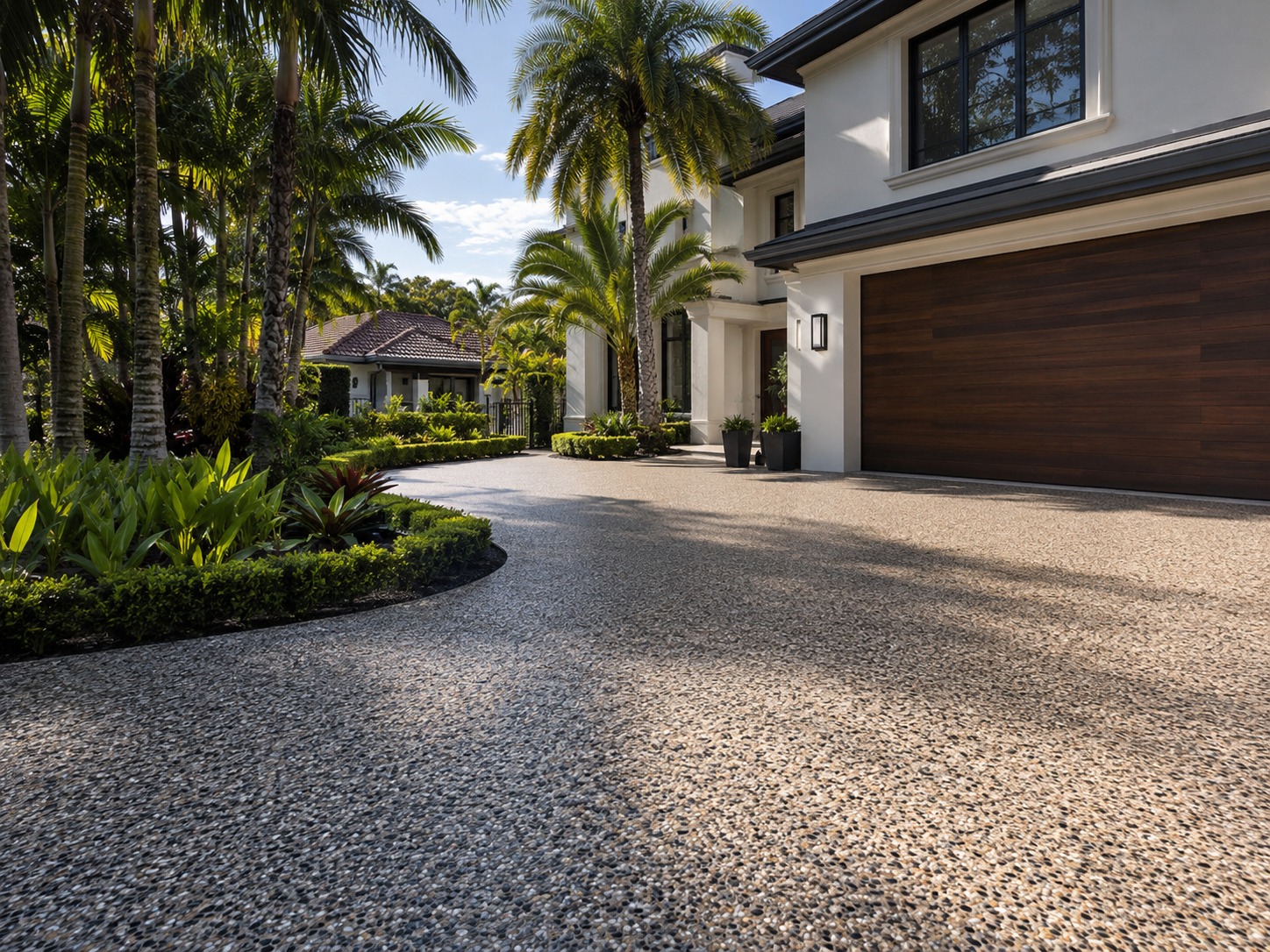
Exposed aggregate takes the same concrete base and reveals the decorative stones inside it. After the slab is poured, the top layer of cement paste is washed away — usually with a surface retarder and a high-pressure wash — to expose the aggregate underneath. The result is a textured, decorative finish that looks like natural stone pebbles set in mortar.
The aggregate itself can be customised. You can choose from local options like:
- Quartz and granite blends — bright, sparkly finishes popular in modern Brisbane builds
- River pebbles — softer, rounded stones in earthy tones
- Crushed basalt — dark charcoal or near-black for a contemporary look
- Coloured glass or recycled aggregate — for statement projects
The colour, size, and density of the stone all affect the final appearance. Larger aggregate gives a chunkier, more rustic look; smaller aggregate looks refined and almost architectural.
Exposed aggregate has become the go-to premium finish for concrete driveways Brisbane homeowners want when they're investing in kerb appeal — particularly across renovated homes in Bulimba, Hawthorne, Ascot, and the inner-west.
Price & Feature Comparison
Let's get the money question out of the way first, because it's usually the deciding factor. Here's how the two finishes stack up across the metrics that matter most to Brisbane homeowners.
| Feature | Plain Concrete | Exposed Aggregate |
|---|---|---|
| Starting Price | From $130/m² | From $150/m² |
| 60m² Driveway | ~$7,800 | ~$9,000 |
| Structural Lifespan | 30–50 years | 30–50 years |
| Natural Grip | Moderate (broom finish) | Excellent — textured stones |
| Summer Heat | Cooler (reflects more) | Can run hotter (dark agg.) |
| Sealing Frequency | Every 3–5 years | Every 2–4 years |
| Resale Appeal | Good | Excellent |
| Ideal For | Budget & traditional homes | Modern, visible driveways |
The 15–20% premium for exposed aggregate buys you a finish that's more visually distinctive and tends to add more to your property's resale value, particularly in Brisbane's design-conscious inner suburbs. Whether that's worth it depends on how much your driveway contributes to the overall presentation of your home.
Durability and Lifespan
Here's where things get interesting. Both finishes use the same underlying slab, so the structural durability is identical. A properly built 100mm slab with appropriate reinforcement will handle Brisbane's clay soils, summer storms, and the occasional heavy vehicle for decades.
Important: The surface finish does not affect structural strength. Plain and exposed aggregate driveways built on the same slab spec will last the same number of years. Your choice is purely about surface appearance, safety, and maintenance.
The differences show up at the surface. Plain concrete is harder to damage cosmetically. Scratches and scuff marks are less visible. When stains do appear — and they will, especially from leaking cars, garden mulch, or fertiliser overspray — they're easier to clean or grind out.
Exposed aggregate is more forgiving in some ways and less in others. The textured surface hides minor wear, leaf litter staining, and the everyday grime that shows up clearly on smooth concrete. However, if individual stones come loose (which can happen on poorly finished jobs), repairs are more visible.
In Brisbane's climate, both finishes need to be sealed to perform at their best. UV exposure, salt air in bayside suburbs like Wynnum and Manly, and the freeze-thaw cycles in elevated areas like Mount Gravatt or The Gap can all accelerate wear on unsealed concrete.
Grip, Safety, and Pool-Adjacent Areas
If your driveway slopes — and many Brisbane properties do, especially in suburbs like Toowong, Indooroopilly, and Kenmore — surface grip matters more than aesthetics.
Exposed aggregate is naturally non-slip because of its textured surface. Even when wet, the exposed stones provide consistent grip. This makes it an excellent choice for sloped driveways, pool surrounds, and pathways where safety is a priority.
Plain concrete with a broom finish performs almost as well in dry conditions, but smooth or trowel-finished plain concrete can become slippery in heavy rain. If you're going with plain, insist on a broom or salt finish — not a smooth trowel.
Safety tip: For pool-adjacent areas or any driveway that connects directly to outdoor entertaining zones, exposed aggregate is usually the safer choice. Its natural texture meets Australian non-slip standards even when wet.
Heat in the Brisbane Summer
This one matters more than people realise. Brisbane summers regularly push surface temperatures above 50°C on dark, sunny pavements.
Plain concrete in its natural light grey reflects more heat and stays cooler underfoot. If you've got kids running barefoot from the house to the pool, or dogs that use the driveway, light-coloured plain concrete is gentler.
Exposed aggregate can run hotter, especially with darker aggregates like basalt or charcoal granite.
Brisbane summer tip: If you love dark exposed aggregate but worry about heat, opt for lighter quartz blends or pale river pebbles — they look stunning and stay considerably cooler underfoot.
Maintenance Reality
Both finishes are low-maintenance compared to pavers or asphalt, but they need slightly different care.
Plain Concrete
- Penetrating sealer every 3–5 years
- Occasional pressure washing to remove dirt and algae
- Prompt cleanup of oil and fuel spills
Exposed Aggregate
- High-quality sealer every 2–4 years (more frequent)
- Careful pressure washing to avoid dislodging stones
- Prompt attention to spills
Red flag to watch for: Any reputable contractor offering concrete driveways Brisbane-wide should include a sealer in their quote or clearly recommend one. If they don't mention it, that's a red flag. A sealer adds 3–8% to project cost but doubles or triples the finish life.
What About Resale Value?
For homeowners thinking about resale, exposed aggregate generally has the edge in Brisbane's competitive property market. Real estate agents across the inner and middle ring suburbs consistently report that a well-presented driveway is one of the first things buyers notice during inspections.
That said, a beautifully laid plain concrete driveway in a coloured charcoal or sandstone tone can look just as premium as exposed aggregate at a lower cost. The deciding factor is often the rest of the home — exposed aggregate suits modern, contemporary builds; coloured plain concrete pairs well with traditional Queenslanders, federation homes, and Hamptons-style renovations.
Choosing Your Finish
Use this quick guide to match the right finish to your situation.
Choose Plain Concrete When…
- Working with a tight budget but want durability
- The driveway is behind a fence or not street-facing
- Matching existing concrete on the property
- Planning to sell within 1–2 years
- The home is a Queenslander or traditional style
- You prefer a clean, minimal aesthetic
Choose Exposed Aggregate When…
- The driveway is front-and-centre on street appearance
- Your home is modern, contemporary, or recently renovated
- The driveway is sloped and grip is a priority
- Investing long-term and want a finish that adds value
- You want better natural dirt & wear concealment
- Driveway connects to pool or entertaining areas
Common Mistakes Brisbane Homeowners Make
After years of working with Brisbane homeowners, the same mistakes come up again and again:
Choosing on price alone
A $20/m² difference works out to $1,200 on an average driveway — small money spread over 30+ years of ownership. Pick the finish that genuinely suits your home.
Skipping the on-site assessment
Brisbane's clay soils, slope variations, and stormwater requirements vary dramatically from suburb to suburb. A quote based on photos or aerial views can miss critical details. Always insist on an on-site visit before signing.
Going with the cheapest quote
Unusually low quotes almost always mean thinner slabs, lighter reinforcement, or skipped steps like proper compaction and drainage. The cost of fixing a failed driveway in five years dwarfs whatever you saved up front.
Forgetting the sealer
A sealer adds 3–8% to the project cost but doubles or triples the life of the finish. Always include it.
Quick Decision Framework
If you're still torn, ask yourself these three questions:
How visible is the driveway from the street?
If it frames the entrance and is seen every day, lean toward exposed aggregate. If it's hidden or secondary, plain is perfectly fine.
Is the driveway sloped or pool-adjacent?
Anything sloped or near water leans toward exposed aggregate for the superior wet-surface grip.
What's your five-year plan?
Staying long-term and investing in the home? Exposed aggregate's premium pays off. Selling soon or budgeting tightly? Plain concrete delivers excellent value.
Get a Proper Quote Before You Decide
Online price guides — including the ones we publish — are estimates. The only way to know what your project will actually cost is a free on-site assessment with experienced Brisbane concrete contractors who can assess your property properly.
Get a Free QuoteRelated Services